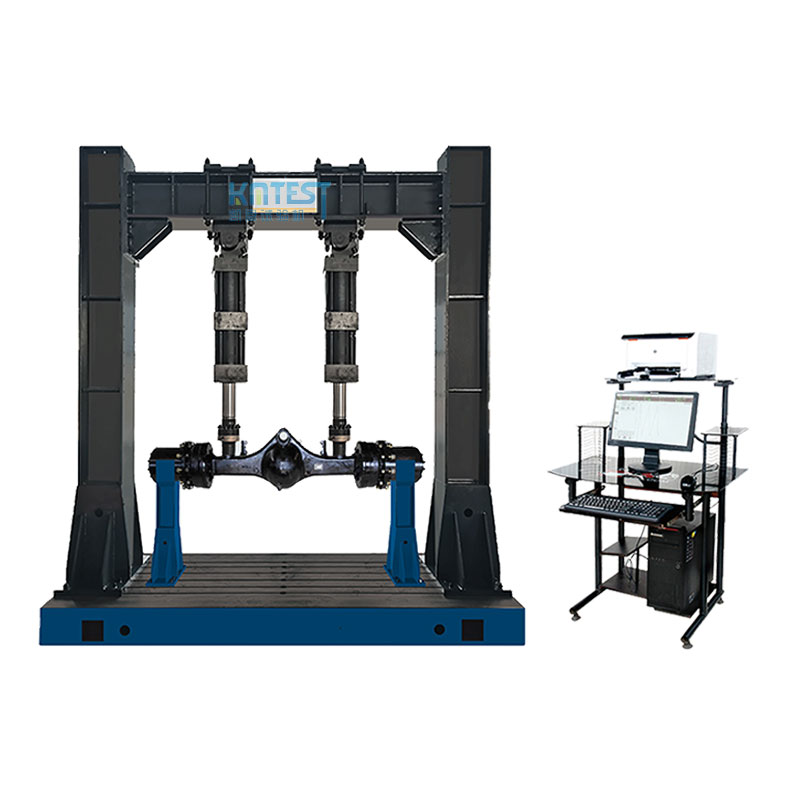
Fatigue test-bed for automobile suspension system

The fatigue test-bed of automobile suspension system completes the quasi-static and quasi-dynamic tests of vehicle and suspension system under multi-road conditions, vehicle modal test, vehicle ride comfort test and NVH performance research, and studies and evaluates the characteristics of key components such as automobile suspension system and seat system....
产品用途

  The fatigue test-bed of automobile suspension system completes the quasi-static and quasi-dynamic tests of vehicle and suspension system under multi-road conditions, vehicle modal test, vehicle ride comfort test and NVH performance research, and studies and evaluates the characteristics of key components such as automobile suspension system and seat system.

  It can meet all kinds of loading signals of real-time road conditions, and it can be fully driven under laboratory conditions. It can accurately simulate the road spectrum function through iterative algorithm, and complete complex actual road simulation tests under laboratory conditions.

  FRF transform and calculation with multi-channel excitation, definable PSD signal, automatic iteration and frequency sweep; Number of channels: four channels and six channels; Parameters are determined according to customization requirements.


产品参数
No.ParameterDetails
1Rated Test Force±25 kN (Indication accuracy: 2% - FS +1%; Amplitude fluctuation: ±0.5% FS)
2Amplitude100 mm (2 sets), 50 mm (2 sets) (Accuracy: ±0.5% FS from 20% indication range)
3Frequency Range0.1 - 10 Hz
4Main WaveformsSine wave, square wave, triangular wave, oblique wave, user-defined combined wave
5Control ModeFull digital PID closed-loop control of force and displacement
6Actuator InstallationHorizontal or vertical installation; Front flange fixed installation
7Oil Source Specifications220 L/min, 21 MPa, 2 × 45 kW
8Maximum Vertical Compressive Load20,000 kN
9Maximum Vertical Tensile Load6,000 kN
10Maximum Vertical Follow-up Load5,000 kN
11Maximum Horizontal Load (Push and Pull)4,000 kN
12Maximum Horizontal Follow-up Load4,000 kN
13Horizontal and Vertical Follow-up Stroke≥ ±250 mm
14Experimental Force Point-by-Point Accuracy≥ ±0.5%
15Experimental Force Detection Range2% - 100% FS (No grading throughout the process)


Quickly Quotation: