

 ENGLISH
 中文
中文 हिन्दी
 ไทย
ไทย 한국어
한국어 FRANÇAIS
 РУССКИЙ
 PORTUGUÊS
 العربية
 TIẾNG VIỆT
| Function | The wire reverse bending tester is used to conduct reverse bend tests on metallic wires, evaluating their ability to withstand plastic deformation under repeated bending and exposing surface or internal defects. |
| Application | This equipment is widely applied in quality supervision, steel manufacturing, construction, and industries producing or utilizing steel wire ropes, electric wires, and cables. |
| Specification | The tester accommodates metal wires ranging from 1 mm to 10 mm in diameter. With optional special fixtures, it can also perform bending tests on wires of other specifications and on various metals. |
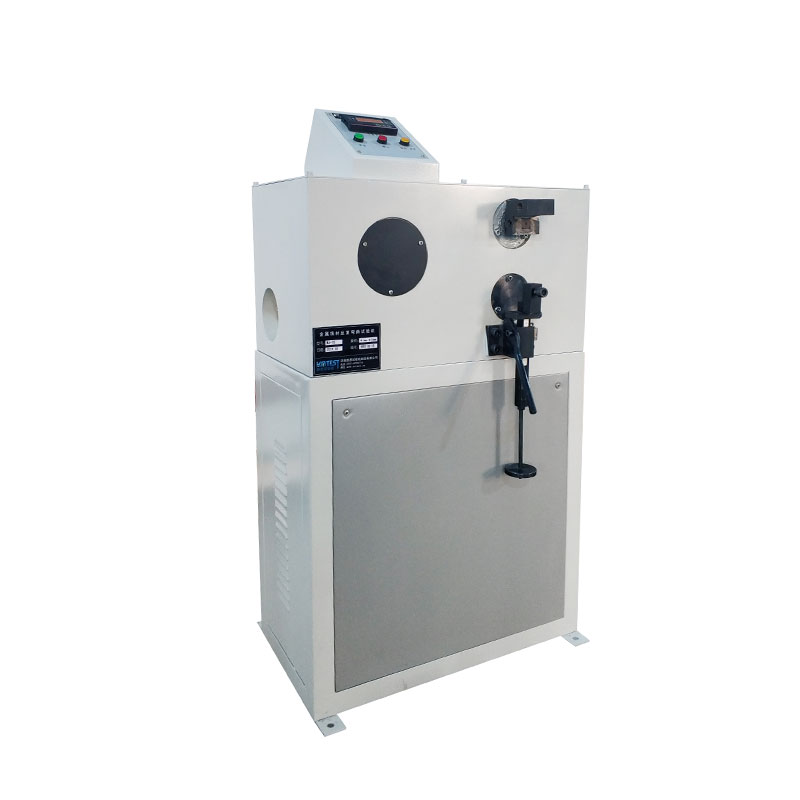
Wire Bending Testing Machine
The wire reverse bending tester is used to conduct reverse bend tests on metallic wires, evaluating their ability to withstand plastic deformation under repeated bending and exposing surface or internal defects....
Product Introduction:
Product Specifications:
| Parameter | Specification |
|---|---|
| Specimen Diameter | 1–10 mm |
| Specimen Length | 150–200 mm |
| Bending Angle | 90° left and right (180° total) |
| Bending Speed | < 60 times/min |
| Counting Range | 0–9999 times |
| Motor Power | 1.5 kW |
| External Dimensions (L×W×H) | 1000 × 600 × 330 mm |
| Machine Weight | 210 kg |
Bending Angle: The specimen is bent 90° to the left and 90° to the right (alternating), completing one full cycle of 180° total deflection.
Bending Speed: Expressed in number of bends per minute (one bend = movement in one direction; a full left-right cycle may be counted as one cycle depending on the standard). Typically, such testers operate at speeds below 60 cycles per minute in accordance with standards like GB/T 238 or ISO 7801.
Counting Range: Records the number of reverse bending cycles until specimen failure.